Evidence-Based Investment Insights: The Essence of Evidence-Based Investing
Explore how evidence-based investing uses academic research, factor models, and diversification to help investors build disciplined, long-term portfolios.

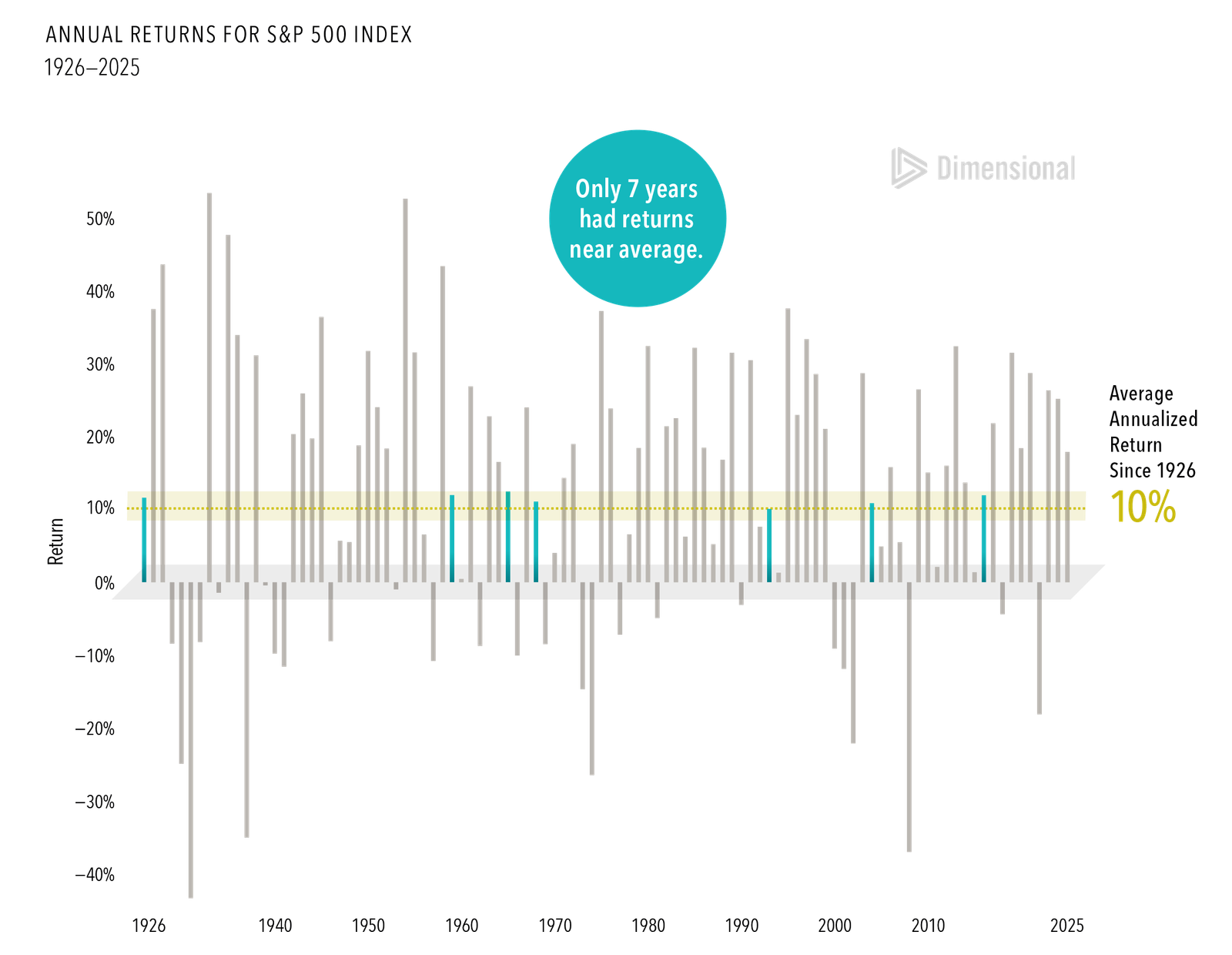
Since 1926, the US stock market has rewarded investors with an annualized return of about 10%. But returns in any given year may be sky-high, extremely poor, or somewhere in between.
Understanding the range of potential outcomes can help you stick with a plan and ride out the inevitable ups and downs.
IMPORTANT DISCLOSURES
This report was first published by Dimensional Fund Advisors LP, an investment advisor registered with the Securities and Exchange Commission.
Past performance is no guarantee of future results. Actual returns may be lower. Investing risks include loss of principal and fluctuating value. There is no guarantee an investment strategy will be successful. Indices are not available for direct investment. Index returns are not representative of actual portfolios and do not reflect costs and fees associated with an actual investment.
In USD. S&P data © 2026 S&P Dow Jones Indices LLC, a division of S&P Global. All rights reserved.
Shore Point Advisors is an investment adviser located in Brielle, New Jersey. Shore Point Advisors is registered with the Securities and Exchange Commission (SEC). Registration of an investment adviser does not imply any specific level of skill or training and does not constitute an endorsement of the firm by the Commission. Shore Point Advisors only transacts business in states in which it is properly registered or is excluded or exempted from registration. Insurance products and services are offered through JCL Financial, LLC (“JCL”). Shore Point Advisors and JCL are affiliated entities.

Explore how evidence-based investing uses academic research, factor models, and diversification to help investors build disciplined, long-term portfolios.

Explore the business of investing, including how stocks, bonds, market risks, and diversification influence expected investment returns.

Learn how diversification can help manage portfolio volatility, reduce concentration risk, and support a more disciplined long-term investment approach.

Learn how diversification and asset allocation can help investors manage systematic and nonsystematic portfolio risk.