ABCs of Behavioral Biases (S-Z)
Learn how sunk cost fallacy and tracking error regret can influence investment decisions and pull investors away from personalized, long-term financial goals.
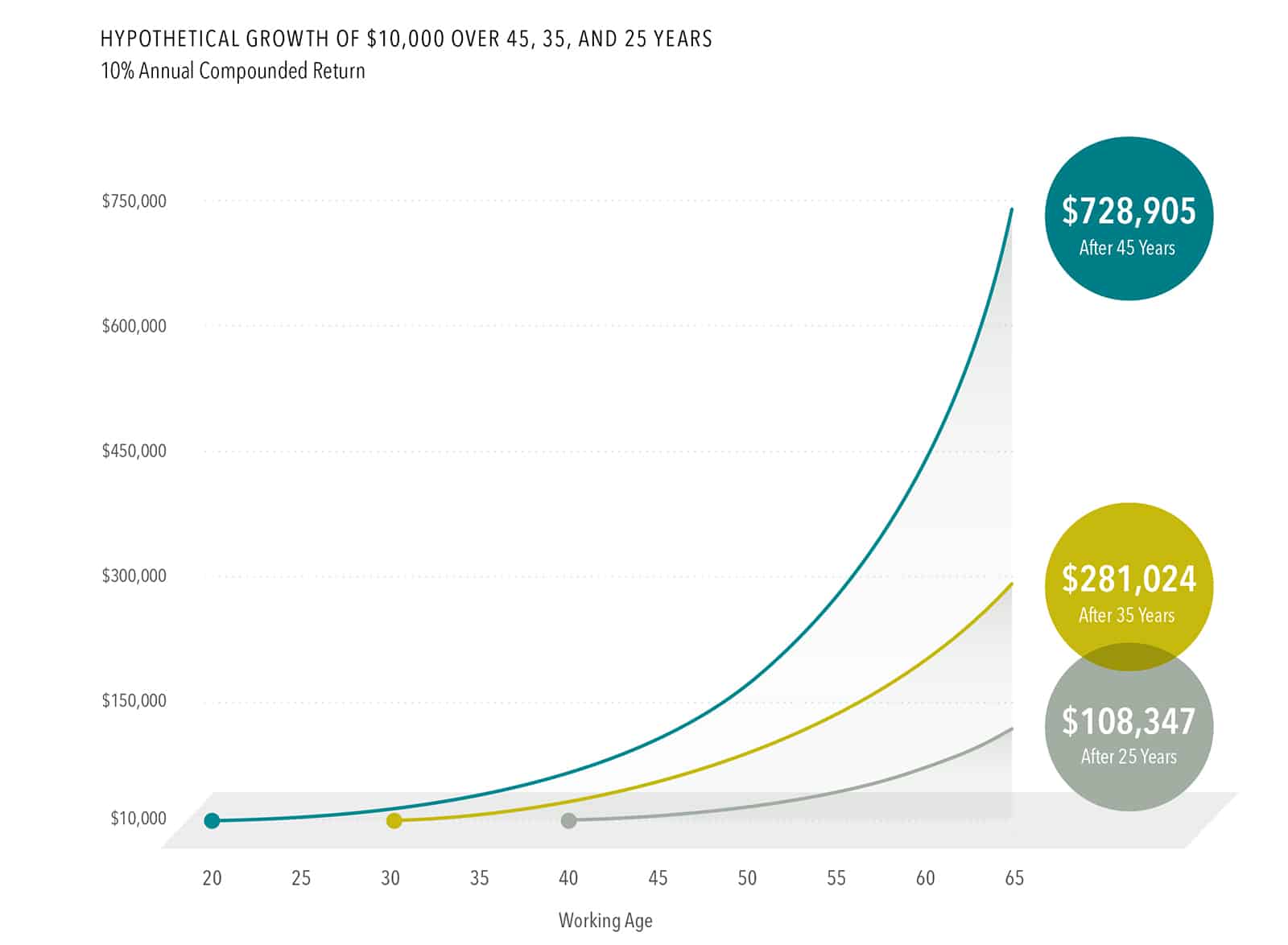
Compounding is a powerful force. When returns are reinvested, the investment’s value can grow exponentially over time.
Compounding can help turn a small investment into substantial wealth. But to harness that power, the sooner you start, the better.
Past performance is no guarantee of future results. Investing risks include loss of principal and fluctuating value. There is no guarantee an investment strategy will be successful.
In USD. For illustrative purposes only. S&P 500 Index annualized return January 1926–December 2025 is 10.42%. S&P data © 2025 S&P Dow Jones Indices LLC, a division of S&P Global. All rights reserved. Dimensional Fund Advisors LP is an investment advisor registered with the Securities and Exchange Commission. Investment products: • Not FDIC Insured • Not Bank Guaranteed • May Lose Value Dimensional Fund Advisors does not have any bank affiliates.
This post was written and first distributed by Dimensional Fund Advisors.
DISCLAIMER
Shore Point Advisors is an investment adviser located in Brielle, New Jersey. Shore Point Advisors is registered with the Securities and Exchange Commission (SEC). Registration of an investment adviser does not imply any specific level of skill or training and does not constitute an endorsement of the firm by the Commission. Shore Point Advisors only transacts business in states in which it is properly registered or is excluded or exempted from registration. Insurance products and services are offered through JCL Financial, LLC (“JCL”). Shore Point Advisors and JCL are affiliated entities.

Learn how sunk cost fallacy and tracking error regret can influence investment decisions and pull investors away from personalized, long-term financial goals.

Explore how overconfidence, pattern recognition and recency bias can influence investment decisions and pull investors away from long-term goals.

Explore how hindsight, loss aversion, mental accounting and outcome bias can influence investment decisions.

Learn how market efficiency shapes stock prices and what it means for building a disciplined long-term strategy.