When Should You Take Your Social Security?
Choosing when to take Social Security is a big decision. Learn how timing, taxes and your overall retirement strategy all work together.
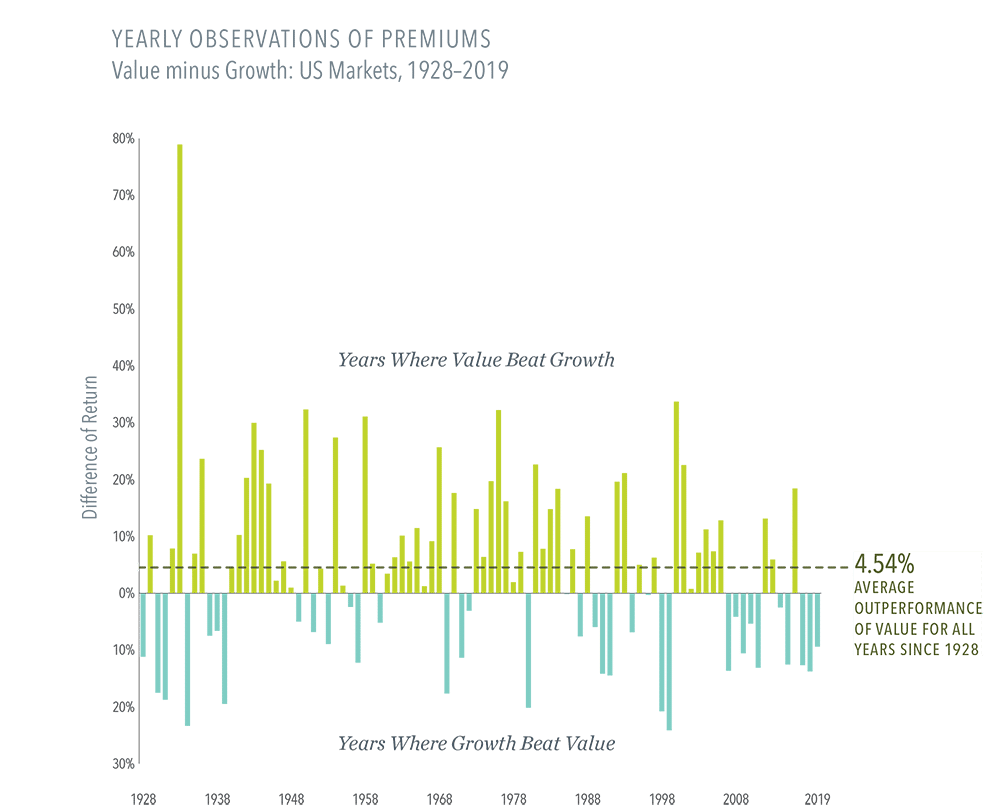
Historically, value stocks have outperformed growth stocks in the United States, though recently that hasn’t been the case. While disappointing periods emerge from time to time, the principle that lower relative prices lead to higher expected returns remains the same.
Logic and history argue for a commitment to value stocks, so investors can be positioned to take part when those shares outperform in the future.
This post was prepared and first distributed by Dimensional Fund Advisors.
Shore Point Advisors is registered as an investment adviser with the State of New Jersey. Shore Point Advisors only transacts business in states where it is properly registered, or is excluded or exempted from registration requirements. Past performance is not indicative of future returns. All investment strategies have the potential for profit or loss. There are no assurances that an investor’s portfolio will match or outperform any particular benchmark. Content was prepared by a third-party provider. All information is based on sources deemed reliable, but no warranty or guarantee is made as to its accuracy or completeness. All expressions of opinion reflect the judgment of the authors on the date of publication and are subject to change.

Choosing when to take Social Security is a big decision. Learn how timing, taxes and your overall retirement strategy all work together.

The start of the new year is a great time for a financial check-up. Here are a few of the issues you should consider.

Review these behavioral finance resolutions to help investors reduce bias, improve decision-making and stay focused on long-term financial goals.

Interpreting bond yields starts with philosophy. Learn why market signals matter and how belief sets shape investment decisions.